Your experienced expert: an asset, or a bottleneck?
They walk your shop floor: those few senior operators who know the machines inside and out. When something goes wrong, they get the call. Great to have people like that, right? Yes, until they leave, get sick, or retire. And then it turns out your production grinds to a complete halt without them. How do you prevent that?
What most companies do
Most production companies work like this: experienced operators solve problems, new operators shadow them and pick things up along the way. Procedures live in SharePoint or a shared folder. And when something genuinely complicated happens, you call the expert.
That approach works. Until it doesn’t.
Your hidden problem
So what if your expert is suddenly out for three weeks on holiday? A breakdown that normally takes 20 minutes now takes four hours. Because nobody else knows where to start.
Or worse: he retires. Every pattern he recognises, every decision he makes intuitively — it all walks out the door with him. And you’re left to deal with the consequences.
We call this problem hidden dependency. You don’t notice it as long as everything runs normally. You only notice it when it’s too late. And then you’re left with only two options:
- Trial and error by other operators (costs time, increases risk)
- Escalating to an external specialist (expensive, slow)
Neither option is acceptable when you have deadlines and a client waiting.

When a breakdown or problem occurred, operators weren’t always able to resolve it on their own. A few highly experienced operators do have the required knowledge. As a result, they were regularly overwhelmed when problems came up.”
Raymond van Dijk, team leader JDE Joure
It’s not about the expert, it’s about their knowledge
The problem isn’t with your experts. It’s a good thing you have them. The problem is that their unique knowledge is not captured or made available. Their expertise is far more layered than a simple work instruction:
Layer 1: Procedures
Every expert knows the procedures. “Set the temperature to 180°C.” “Check the pressure every 30 minutes.” Most companies have documented this somewhere.
Layer 2: Decision logic
Almost no company has documented the second layer: the decision logic. “If you hear this sound at this temperature, it’s caused by air pockets in the line.” “With raw material from supplier A, you need to set it 5 degrees higher than with supplier B.”
This is the knowledge that separates a junior operator from a senior one. It’s not in the procedures. It’s in their head.
Layer 3: Pattern recognition
The third layer is rarely captured either. This is pattern recognition: seeing a combination of signals and immediately knowing what’s going on. “The machine is running 0.2 seconds slower, the temperature is stable, but the end product has a colour deviation. It’s wear on roller 3.” This knowledge isn’t in any procedure. You learn it by going through it hundreds of times.
In short: the most essential process knowledge (layers 2 and 3) lives only in the head of the expert. And that makes every expert a potential bottleneck.
How this plays out in practice
At JDE Joure, part of JDE Peet’s and producer of Douwe Egberts coffee among others, they encountered this problem in the Liquid Packaging department. This is where a liquid coffee solution for the hospitality industry is packaged.
Team leader Raymond van Dijk: “When a breakdown or problem occurred, operators weren’t always able to resolve it on their own. A few highly experienced operators do have the required knowledge, as do the team leaders and the production manager. As a result, they were regularly overwhelmed when problems came up.”
The cost of hidden dependency (that you’re already paying)
Dependency costs money, in all kinds of ways.
In time
How many hours a week does your best operator spend answering the same questions? Explaining how things work? Solving problems nobody else can handle? Those are hours he isn’t spending on producing or optimising.
In growth
How many orders have you already had to turn down because you don’t have enough people who can work independently? How many growth opportunities are slipping by because training simply takes too long?
In risk
What does one hour of downtime cost you? And how many hours of downtime are you risking if your expert unexpectedly drops out?
The solution: capture your experts’ knowledge
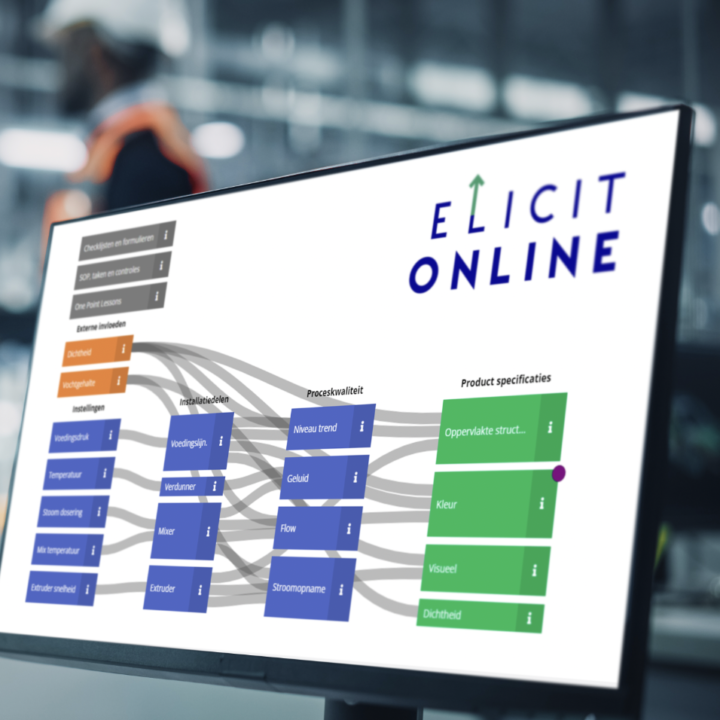
JDE Joure decided to use ELICIT to capture the knowledge of their experts. Through interviews, all knowledge layers were recorded and made accessible to colleagues via a knowledge system. An operator now knows exactly which “levers” they are allowed to adjust, at what moment, and which tasks they can hand off to the Technical Service team.
Jan Jonker, operator with over 30 years of experience: “Colleagues can now troubleshoot much more independently. When I used to show the old system to a new operator, that was difficult. But in ELICIT Online you can click on a specific component and immediately see the relevant information.”
The result? Raymond van Dijk: “Where’s the biggest win? Fewer questions and shorter downtimes. We arrive at solutions faster and see fewer quality deviations. The unplanned stops are significantly shorter. We’re able to resolve problems earlier, which means the major, lengthy breakdowns occur less often.”
“Colleagues can now troubleshoot much more independently. When I used to show the old system to a new operator, that was difficult. But in ELICIT Online you can click on a specific component and immediately see the relevant information.”
Jan Jonker, operator with over 30 years of experience
Signs that it’s time to act
Do you recognise at least two of these signs on your shop floor? Then you’re dealing with hidden dependency too.
- Your new operators still can’t handle deviations independently after months
They can follow the standard procedure, but the moment something deviates, they have to wait for a senior. They don’t know when they’re allowed to step off the procedure, which parameters are critical, or how to prioritise when multiple warnings come in at once. - Your best operators are constantly interrupted with the same questions
“How do I fix this?” “What does this error message mean?” Your experts give the same explanation to different people every week and never get to the work you actually need them for: optimising, improving, solving complex problems. - Breakdowns take longer when certain people aren’t around
A problem that normally takes 20 minutes suddenly takes two hours. Nobody knows where to start. Or operators try everything, which actually makes the problem worse or causes quality deviations. - You can’t handle orders or growth because you can’t train people fast enough
Every new production line or extra shift means new people. But who trains them? Your experienced operators are already stretched thin. And even if you make the time, it takes months before someone can work independently. Growth is limited by training capacity. - You see quality deviations that get picked up too late
Junior operators can tell something’s off, but they don’t recognise what it means. They wait until the problem gets bigger or call for help too late. Where an experienced operator would have stepped in at the first signs, production continues running with deviations.
Are you too dependent on your experienced expert?
We’d be happy to tell you how to get ahead of the risks. Schedule an introductory call and discuss your situation. No obligations, just a relaxed conversation about what fits your production process.
Relevant subjects

What are organizations' top 6 challenges in capturing expertise?
Capturing expert knowledge is critical for organizations to succeed and stay successful. Whether capturing knowledge about internal processes or capturing knowledge from external experts, capturing this knowledge can be the difference between success and failure.
In this article, we will discuss the top 6 challenges companies face when capturing expert knowledge.

Train faster and more effectively
Manufacturing companies are constantly looking for ways to improve efficiency and productivity. Yet they often cling to outdated training methods.
Consider the long days spent in training rooms, where employees are inundated with information about complex machines and systems. The reality is that by the time we need that second cup of coffee, our focus is already lost.

Optimizing OEE with a knowledge base: how does it work?
Overall Equipment Effectiveness (OEE) is an excellent method to measure your machine efficiency. But how do you turn measurements into concrete improvements? By combining it with a knowledge base filled with (expert) knowledge. How does that work? Let us explain.
POKA, EZ GO, ManualMaster and ELICIT: What’s the difference?
Knowledge management tools all promise the same thing: capturing knowledge, supporting operators, and speeding up training. But how do they actually differ? And which problems do they solve for you? We discuss three well-known solutions, POKA, EZ GO, and ManualMaster, and compare them with ELICIT.
Optimizing OEE with a knowledge base: how does it work?
Overall Equipment Effectiveness (OEE) is an excellent method to measure your machine efficiency. But how do you turn measurements into concrete improvements? By combining it with a knowledge base filled with (expert) knowledge. How does that work? Let us explain.
Kennis delen zit in ons DNA